Who Belongs in Hip-Hop? A Look at Identity and Inclusion in the Culture
More Than Music
Hip-hop has never been just about music, it’s a way of life, a cultural force, and for many, such as myself, a home. But who really gets to belong in this space? Who feels welcomed, and who doesn’t? After diving into the online hip-hop world through the subreddit r/hiphopheads and comparing it to academic studies, the answer is complicated, but revealing.
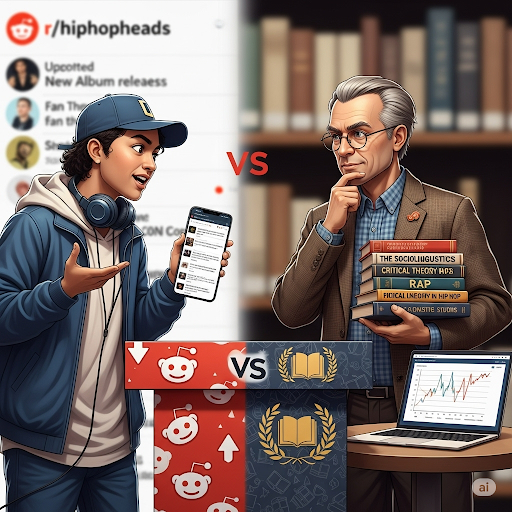
Created using Gemini
Unspoken Rules in Digital Spaces
On Reddit, r/hiphopheads is one of the largest online hangouts for fans of hip-hop. With over 5 million members, it provides everything from lyrical breakdowns and album debates, to cultural hot takes and political movements. Everything to jump into the genre.
Even with how open and easy it is to get involved with the subreddit, the community still has unspoken rules. There’s a sense of respect to those who have deep knowledge of hip-hop history, show respect for the foundational artists, and who love lyrical rap. For example, fans of artists like Nas, Kendrick Lamar, or MF Doom often get more respect than fans of the newer artists. Though not officially stated, you can sense that vibe from the interactions on the comment sections and the upvotes.
Hip-hop as a Teaching Tool
This closely resembles what Daniel Banks says in his essay, Hip-Hop as Pedagogy: Something from Something. Banks argues that hip-hop teaches through lived experiences and storytelling. Hip-hop gives the marginalized youth a space to build an identity and become confident. This identity in hip-hop is often tied to struggle, authenticity, and truth-telling. People who live or understand that experience feel more welcomed. Those who don’t, or those who treat hip-hop only as a form of entertainment, often feel like outsiders, or maybe even “guests” in hip-hop.
Academic Recognition of Hip-Hop Identity
Then there’s Harvard’s Hip-Hop Archive and Research Institute (HARI). HARI values identity differently. Their goal is to study and preserve hip-hop’s language, history, and politics. Through programs like the Nasir Jones Fellowship, artists and scholars who use hip-hop to push for change are celebrated. This shows that even elite institutions are starting to validate hip-hop’s identity as education and transformative. A vast different from the rebellious and raw hip-hop started out as.

Hip-Hop Archive & Research Institute in Harvard logo (https://sites.harvard.edu/hiphoparchive/)
Barriers to Belonging
Still, not everyone fits in easily. Women in hip-hop, especially fans and artists, often face gatekeeping. International fans might love the music, but struggle to be seen as “true” members of the culture. That’s where communication styles, slang, and knowledge help play a role in separating the insiders from the outsiders. The “guests”.
Who Holds the Power?
So, who really benefits? Those who are judged by the group to have deep knowledge, good taste, and an understanding of hip-hop’s cultural roots usually do. The casual listeners, the pop fans, or people new to the genre may feel left out or hesitant to speak up.
Conclusion: Identity through Engagement
In the end, identity in hip-hop is earned through respect, authenticity, and understanding. Whether we’re speaking about the culture through Reddit threads or Harvard, those who engage deeply, and not just consume, are the ones valued.
.jpg)


Comments
Post a Comment